HOW THINGS WORK III CONFERENCE
Report on the
3rd Annual Conference on How Things Work
Held on April 21, 2026
Report date: 9/30/2026. Published: 10/30/2026
Prepared by Mike Zamm
Environmental Education Advisory Council of NYC
TABLE OF CONTENTS
INTRODUCTION — PROBLEM SOLVING WITH EARTH AND ITS SYSTEMS
- ENERGY TECHNOLOGIES
- • Association for Energy Affordability (AEA)
- How to Implement Energy Efficiency in Existing Buildings; How Does an Induction Stove Work; Through the Bronx/Brooklyn Energy Hub, How Does Community Solar Work• American Museum of Natural History
How Do Solar Collectors Work and Other Science Education Initiatives
- How to Implement Energy Efficiency in Existing Buildings; How Does an Induction Stove Work; Through the Bronx/Brooklyn Energy Hub, How Does Community Solar Work• American Museum of Natural History
- • Empire Clean Cities
- How a Hydrogen Fuel Cell Bus Works and Other Green Energy Transportation Alternatives
- • New York League of Conservation Voters Education Fund (NYLCVEF)
- How Clean Energy Leads to a Sustainable Environment and Green Jobs
- • New York Power Authority and New York Transco/Propel NY Energy
- How Does a Transmission Solution to Propel New York State’s Renewable Energy Future Work
- • NineDot Energy
- How Do Battery Energy Storage Systems Work
- • Patterson Garage
- How Does an Electric Vehicle Work
- • Windscape
- How Does an Offshore Windmill Work
- • Association for Energy Affordability (AEA)
- STORMWATER MANAGEMENT AND COMMUNITY RESILIENCE
- • Bronx River Alliance
- How Stormwater Management Works
- • Bronx Community College
- Poster Exhibit on How NYC Can Manage Stormwater Through Rain Gardens
- • Killer Snails
- How is Potable Water Delivered to Homes
- • New York City Department of Parks and Recreation
- How Does Runoff Enter Our Lands and Waters and How Can We Manage It
- • Studio HIP
- How a Water Retention System Works
- • Bronx River Alliance
- GREEN SPACES/FOOD SYSTEMS
- • Bronx Community College
- Poster Exhibit on How to Create Sustainable Cities
- • Bronx Community College
- Poster Exhibit on How to Analyze the Microbial Impact of Goose Excrement on the Microbial Biodiversity of Soil on the BCC Campus Green Areas
- • Bronx Council for Environmental Quality (BCEQ)
- How to Improve the Health and Recreational Use of the Harlem River
- • New York Botanical Garden/Bronx Green-Up
- How are Community Gardens in the Bronx Providing Access to Food, Building Spaces for Healing and Education While Leading the Fight Against Toxic Pollution
- • Brotherhood Sister Sol
- How Does Hot Box Composting Work
- • New York City Parks Stewardship Program
- How Does Street Tree Care Facilitate Habitat Restoration
- • Rethink Food
- How to Create a More Sustainable and Equitable Food System
- • The Bronx is… Blooming
- How to Make a Seed Bomb
- • The Hort
- Pollinators are Everywhere
- • Bronx Community College
- PUBLIC AND PERSONAL HEALTH
- • Albert Einstein College of Medicine
- How Your Lungs Work
- • Biobus
- How a Microscope Works
- • Bronx Community College
- Poster Exhibit on How to Implement Weather Aided AI Calibration of Monsoon Rainfall in India
- • Bronx Tech Hub
- How to Bring Training in Climate Related Technology to the Bronx
- • New York City Department of Health and Mental Hygiene (DOH)
- How Climate Change Contributes to Mosquito-Borne Diseases in NYC; How Diseases are Transmitted by Mosquitoes and How Disease Can Be Prevented
- • New York City Department of Transportation (DOT)
- How Can Traffic Fatalities in NYC Be Reduced; How Can We Reduce Our Carbon Footprint
- • New York Sea Grant
- How to Remove Plastic from Water
- • South Bronx Unite
- How Can the Mott Haven Community Work to Make Air Quality, Housing and Land Use Better for Its Inhabitants
- • Unearthing Air with Todd
- How to Measure Indoor Air Quality
- • Wave Hill
- How Can Youth Learn About Urban Biodiversity, Forest Health and Climate Change
- • Albert Einstein College of Medicine
INTRODUCTION — PROBLEM SOLVING WITH EARTH AND ITS SYSTEMS
Young people have an innate curiosity about the world around them. They want to learn how things work. Earth science teachers hold classes spellbound with lectures on how the Earth and its Solar System evolved. Youth engagement significantly increases when they are involved in hands-on activities that help them explore the mechanics underlying how systems function.
As we go further into the twenty-first century it is essential that young citizens know how things work so they can make intelligent decisions as consumers, voters, and community participants.
On April 21, 2026, Bronx Community College (BCC), the Environmental Education Advisory Council (EEAC) and the James Baldwin Outdoor Learning Center held the third annual How Things Work (HTW) conference on the BCC campus. Thirty organizations set up exhibits to help 150 middle school, high school and college students investigate how a variety of environmental systems work. Most of the exhibits, in one way or another, stressed how the specific system connects to the world around us and to climate change and what students can do to have a positive effect on preserving the Earth.
WELCOMING SESSION
The How Things Work Conference welcomed students in the Roscoe Brown Playhouse Auditorium. The playhouse is named after the Tuskegee Airman who was president of BCC for sixteen years and played a major role in shaping it into the excellent school it is today.
The initial 22 student attendees and their four teachers from University Heights High School and MS 247 were treated to a stimulating presentation from Sue-Moura Burke, a Green Action Challenge Student Ambassador.
Sue-Moura spoke to the youth about how her experiences with the Green Action Challenge piqued her interest in environmental issues.
She also described the innovative work being done by BCC students in India where BCC faculty and students monitored air pollution. BCC faculty and students have set up weather stations in several regions of the country.
Sue-Moura described the growth of jobs in the environment and the impact of AI on environmental work. She had just returned from her second trip in India where she worked with a team of BCC students to develop an AI model for the monsoon rainfall in India. She stressed that it is important that humans and not runaway AI are in charge of analyzing environmental problems and implementing solutions. She shared insights for financial aid and gave tips for time management to prepare students for college.
As the students left the playhouse, they were met by other youth from a third school and as they arrived at the exhibit hall, other public school youth and BCC students emerged.
LIST OF SCHOOLS AND NUMBER OF STUDENTS
PS 469X, THE BRONX SCHOOL FOR CONTINUOUS LEARNERS (6–12 grades) — 12 Students
UNIVERSITY HEIGHTS HIGH SCHOOL and
MS 247 — 22 Students from both schools
IS 313, SCHOOL OF LEADERSHIP DEVELOPMENT — 12 Students
MOTT HAVEN COMMUNITY HIGH SCHOOL (10–12 grades) — 21 Students
DUAL LANGUAGE MIDDLE SCHOOL (6–7 grades) — 10 Students
BRONX COMMUNITY COLLEGE TALENT SEARCH PROGRAM (6–12 grades) — No number recorded.
CUNY EXPLORERS (6–10 grades) — 20 Students
BRONX COMMUNITY COLLEGE — 50 students signed up, but a significant number attended but didn’t sign in. It is estimated that at least 60 BCC students participated.
TOTAL NUMBER — APPROXIMATELY 150
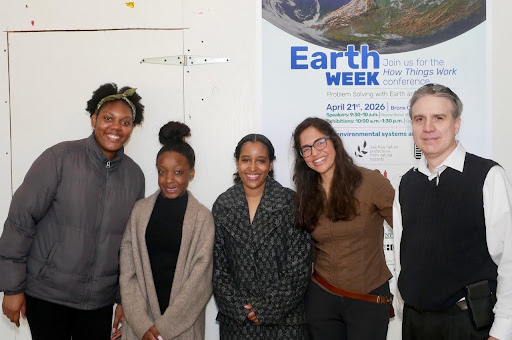
from left), with BCC students and staff.
THE EXHIBITS
The exhibits belong in one of four categories: energy technologies, green spaces and food systems, stormwater management and community resilience, and public and personal health. They could also be divided between those demonstrating technical processes and those focused on social processes. The environmental and social systems present at the conference are described below.
ENERGY TECHNOLOGIES
• Association for Energy Affordability (AEA)
How to Implement Energy Efficiency in Existing Buildings; How Does an Induction Stove Work; Through the Bronx/Brooklyn Energy Hub, How Does Community Solar Work
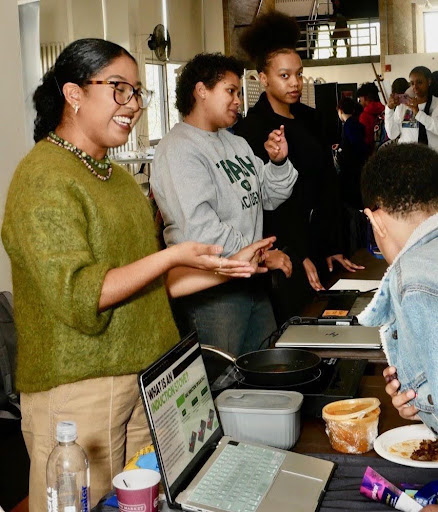
AEA’s exhibit stressed their training programs for contractors, property owners and others in applying weatherization techniques in buildings. A major goal of this training is to help participants have a better understanding of the important role that installation of cold climate air source heat pumps is expected to play in New York State and New York City to achieve their greenhouse gas emission reduction goals. AEA also explained that this technology is now being promoted by the New York State Energy Research and Development Authority (NYSERDA) and utilities throughout the state because it is an effective way to increase energy efficiency.
Heat pumps heat and cool homes by moving existing heat around using electricity and refrigerant rather than generating heat through combustion. In winter they extract heat from outside air or the ground, compressing it to higher temperatures before releasing it indoors. In summer the pump reverses this process to act as an air conditioner, removing indoor heat.
AEA also offers ventilation standards training. As homes are sealed tighter, they require proper ventilation to minimize the potential for moisture and durability issues.
AEA courses explore how to evaluate existing ventilation systems using tools such as anemometers and barometers, and how to calculate the correct ventilation needs of the building. (Source: https://aea.us.org)
The main attraction of the exhibit showcased how an induction oven works. Induction cooking uses electromagnetic energy to directly heat your cookware. Induction stoves only heat the cookware leaving the surface cool to the touch, reducing the risk of burns or fires. No combustion means no indoor air pollution. (Source: https://nyforcleanpower.org/)
The AEA exhibit also highlighted the Bronx/Brooklyn Energy Hub (https://bxbkenergyhub.org/en/) Attendees learned about their Community Solar Program which lets participants use solar energy without needing solar panels on the roof. The key to this is sharing a large solar-powered system with others in your area. Community Solar lets people share a large, local solar system to lower the Con Ed bill through solar credits. Contact Bronx/Brooklyn Energy Hub for more information on how to participate.
Contact: eastcoastinfo@aea.us.org, 212-279-3902
connect@bxbkenergyhub.org, 1-859-636-3749
• American Museum of Natural History
How Do Solar Collectors Work and Other Science Education Initiatives
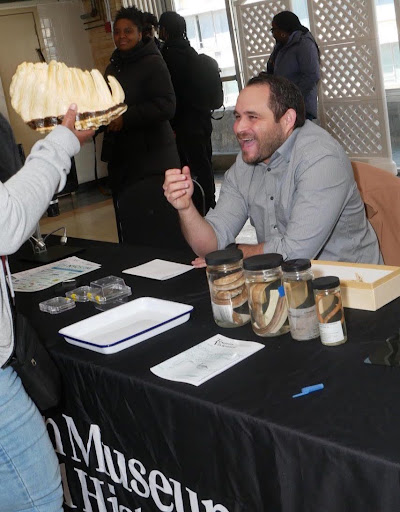
The exhibit helped students learn how a solar collector works. Collectors possess arrays of photovoltaic solar cells which absorb the light energy of the sun. This in turn causes the cell material, usually silicon, to generate a flow of electrons which becomes a usable electric current. The electricity is then routed to your home or the electrical grid.
The exhibit also featured the Science Research Mentoring Consortium (NYCSRM Consortium) where participating youth work with a scientist on research for at least 100 hours. There are 30 different mentored paid research programs in the Consortium with research in ecology, environment, cancer biology, astrophysics, anthropology, chemistry, engineering and more. (Source: NYCSRM Consortium fact sheet).
Contact: NYC Science Research Mentoring Consortium, https://www.studentresearchnyc.org/
• Empire Clean Cities
How a Hydrogen Fuel Cell Bus Works and Other Green Energy Transportation Alternatives
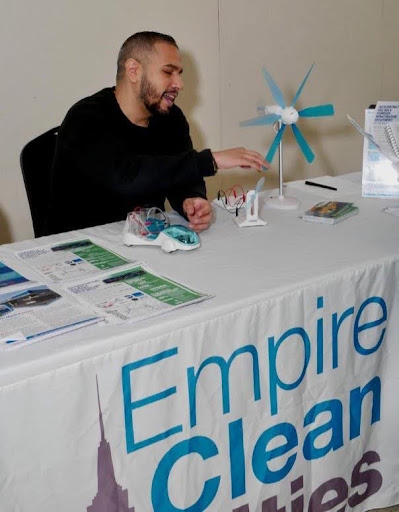
Hydrogen fuel cells generate electricity by reacting to hydrogen and oxygen in the presence of a platinum catalyst, the byproduct of which is water. The catalyst separates hydrogen molecules into protons and electrons. The electrons go through an external circuit, creating a flow of electricity. This electricity is used as the power source for an electric motor which drives the wheels of the bus.
This exhibit featured demonstrations and educational materials about how hydrogen fuel cell buses work and the benefits of this type of vehicular transportation. The hydrogen fuel cell bus is a new type of zero-emissions vehicle technology.
Through a grant from the New York State Energy Research and Development Authority two hydrogen fuel cell buses will be deployed on eight bus routes in the Bronx. The buses will be supported by a new hydrogen fueling station at the MTA’s Gun Hill Depot. The buses will save 50,000 gallons of diesel fuel per year, reducing local air pollution in the Bronx.
The exhibit also showcased the replacement of diesel-powered ground support equipment with zero-emission battery-electric models by Delta Air Lines at JFK Airport as well as efforts with partners to deploy sustainable methods of reducing traffic emissions and congestion. (Source: Empire Clean Cities fact sheets)
Contact: Empire Clean Cities, https://www.empirecleancities.org, 212-839-7728
• New York League of Conservation Voters Education Fund
(NYLCVEF)
How Clean Energy Leads to a Sustainable Environment and Green Jobs
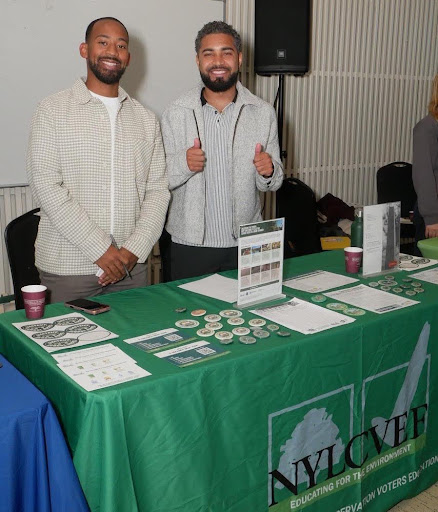
The NYLCVEF staff discussed with students how the organization’s statewide priorities: zero waste, battery storage, green spaces, clean energy/green transportation, clean water and energy efficient buildings, all lead to a healthier, more sustainable environment for New York City.
Implementing these priorities can lead to green jobs. How to bring this transformation about: voting, signing petitions, calling your representatives, signing up for the NYLCVEF email list, joining their emerging leaders’ program.
Contact: https://nylcvef.org/
• New York Power Authority and New York Transco/Propel NY Energy
How Does a Transmission Solution to Propel New York State’s Renewable Energy Future Work
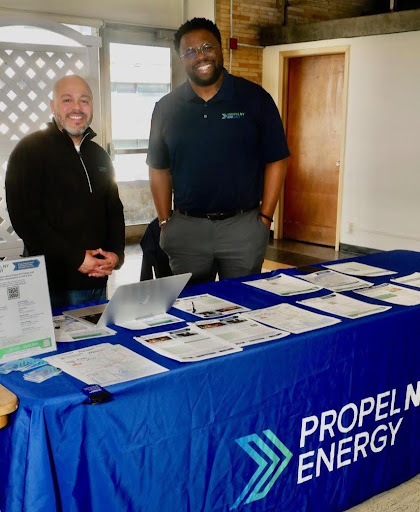
The exhibit showcased a partnership between The New York Power Authority (NYPA) and New York Transco to advance Propel NY Energy, an innovative electric transmission project that will improve reliability and resiliency and the delivery of clean energy, including offshore wind, through electric grid improvements in parts of Long Island, New York City and Westchester County.
The electric transmission grid is the backbone of energy delivery. It is made up of the high-voltage transmission lines that carry electricity long distances and substations that transport energy from where it’s created to where it is used. Like the roads we travel, it is core infrastructure that we rely on everyday and our increasing demands for more energy and cleaner electricity require grid improvements throughout New York State.
(Source: Propel NY Energy fact sheets, https://www.propelnyenergy.com/overview,
PDF from propelnyenergy.com menu “Project Background” > “Project Fact Sheet (English)”)
Contact: info@propelnyenergy.com, 1-800-347-9071
• NineDot Energy
How Do Battery Energy Storage Systems Work
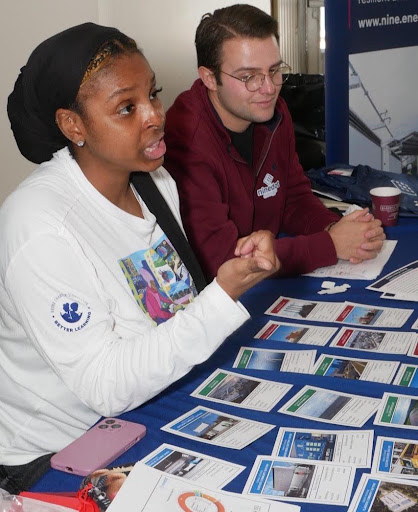
NineDot is a Brooklyn-based clean energy developer, building battery energy storage systems across New York City. Their storage systems capture and store energy generated by renewable sources and release it back to the electricity grid at periods of high demand.
Energy storage works by charging batteries overnight when there’s lower energy demand and therefore excess energy to store. The batteries hold their charge until the utility “calls” for help during times of peak demand. The batteries discharge their energy to the grid to meet customer needs. The batteries stay discharged until they charge up again between midnight and 8 AM. (Source: NineDot fact sheet)
Contact: https://nine.energy/connect
• Patterson Garage
How Does an Electric Vehicle Work
Based at Bronx Community College, Patterson Garage offers students a curriculum in Automotive Technology including courses in Introduction to Electric Vehicles and Electric Vehicle Performance and Diagnosis.
Electric vehicles significantly decrease greenhouse gas emissions compared to traditional cars. Electric cars use a battery pack to store electrical energy that powers the drive motor. Batteries are charged by plugging the car into an electrical power source. They can further combat climate change by utilizing renewable energy sources for charging the batteries.
Students at the conference were educated by a Patterson Garage staffer about how a Nissan Leaf, an electric subcompact SUV, operates.
Contact: 718-289-5100; Parking lot at BCC, 171 Hall of Fame Terrace, Bronx, NY, 10453, https://www.bcc.cuny.edu
• Windscape
How Does an Offshore Windmill Work
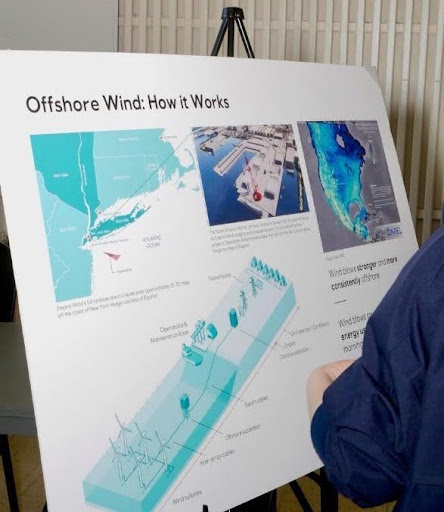
This exhibit showed how electricity is generated in an offshore windmill. Students learned that the mechanical energy of the wind turns the wind turbine which has a generator with an enclosed magnet inside a coil creating, based on the Principle of Induction, an electric current.
The table showcased Empire Wind, an offshore project 15 miles southeast of Long Island that will include 54 turbines that will provide over 810 gigawatts of power, enough to power 500,000 homes. Empire Wind electricity will be delivered directly into Brooklyn and will be the first wind farm to deliver electricity to New York City.
Power generators known as nacelles, monopole tower sections and turbine blades will be assembled at staging areas. Voltage conversion for connection to New York’s electric grid will occur at an onshore substation on the Gowanus. (fact sheet, Equinor, 2026).
Contact: empirewind@equinor.com, https://www.equinor.com/where-we-are/us-renewables
STORMWATER MANAGEMENT AND COMMUNITY RESILIENCE
• Bronx River Alliance
How Stormwater Management Works
The Alliance presented to students a model for helping cities become resilient in the face of climate change. Their table contained descriptions of a variety of stormwater retention techniques such as a retention basin, green roof, rain garden and an urban forest, all of which absorb stormwater and prevent runoff, flooding and combined sewer overflow (CSO).
(See Studio HIP for more CSO information.)
Contact: info@bronxriver.org, 718-542-4124, https://bronxriver.org
• Bronx Community College
Poster Exhibit on How NYC Can Manage Stormwater Through Rain Gardens
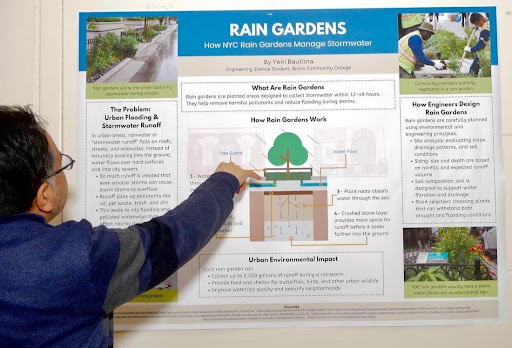
Rain gardens are planted areas designed to collect stormwater within 12–48 hours. The plants help remove harmful pollutants by filtering water and reduce flooding by absorbing stormwater.
Engineers design rain gardens through site analysis, slope evaluation, drainage patterns and soil conditions. Plants are chosen that can withstand both drought and flooding conditions.
Contact: Elena Perez, elena.perez@bcc.cuny.edu, BCC Green Action Challenge
• Killer Snails
How is Potable Water Delivered to Homes
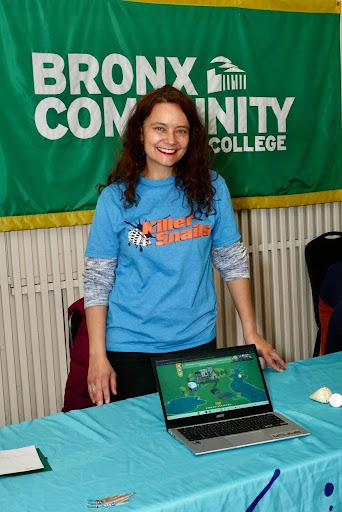
This table focused on wastewater treatment plants and using green infrastructure to manage stormwater. Green infrastructure such as rain gardens and green roofs will capture and absorb stormwater preventing combined sewer overflow (CSO) and allowing sewage treatment plants to clean water and return it to surrounding waters so as to maintain water quality for fishable and swimmable waters, and for drinkable water in some locations.
See CSO description in Studio HIP project section.
Contact: https://www.killersnails.com/
• New York City Department of Parks and Recreation
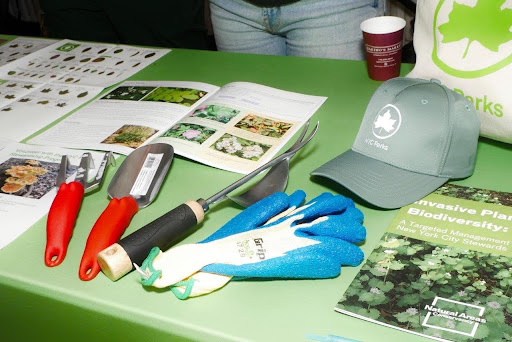
How Does Runoff Enter Our Lands and Waters and How Can We Manage It
Parks staff taught students how all kinds of waste from regular garbage to toxic chemicals are deposited by individuals and industries into our ecosystem and then carried by precipitation into our coastal land area and waters.
Contact: https://www.nycgovparks.org, https://www.nycgovparks.org/learn/sustainability/cleaning-our-water-and-protecting-flood-prone-communities
• Studio HIP
How a Water Retention System Works
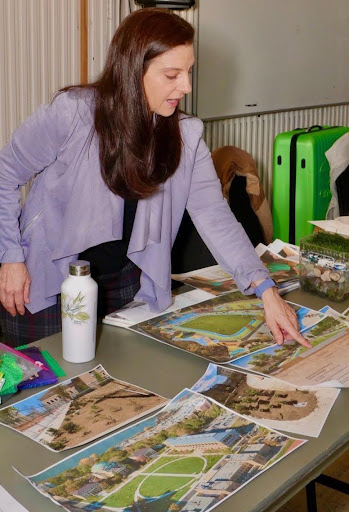
Organized by a representative of the American Society of Landscape Architects, this exhibit demonstrated to attendees a water retention system that manages stormwater runoff and prevents the negative effects of combined sewer overflow (CSO).
CSO’s occur during and after heavy rainfall when stormwater runoff mixes with water from people’s homes into combined sewer pipes leading to a sewage treatment plant. The water overwhelms the wastewater treatment system thus releasing untreated sewage into the waters around the city.
Curbside gardens, green roofs and other more absorbent landscape features (as well as reducing water use during rain events) are designed to prevent harbor water pollution and the cessation of water related activities by retaining rainfall and preventing too much water from rushing into the combined sewer system.
Contact: Jennifer Nitszky, jnitzky@gmail.com, https://www.studiohip.nyc
GREEN SPACES/FOOD SYSTEMS
• Bronx Community College
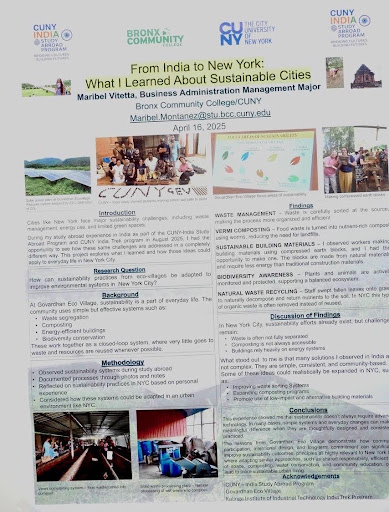
Poster Exhibit on How to Create Sustainable Cities
BCC student Maribel Montanez studied sustainability on her field trip abroad in India. She reviewed how sustainability practices from eco-villages can be adapted to improve environmental systems in NYC. She concluded that in many cases simple systems and everyday changes can make meaningful differences when they are thoughtfully designed and consistently applied.
Sustainability practices relevant to NYC are composting, water conservation, efficient use of space, energy efficient buildings, and waste segregation, all buoyed by community education.
Contact: Elena Perez, elena.perez@bcc.cuny.edu, BCC Green Action Challenge
• Bronx Community College
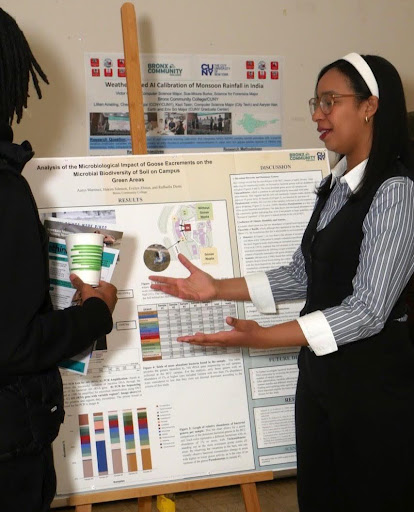
Poster Exhibit on How to Analyze the Microbial Impact of Goose Excrement on the Microbial Biodiversity of Soil on the BCC Campus Green Areas
This poster gives a specific description of this study. Refer to the contact for more detail.
Contact: Elena Perez, elena.perez@bcc.cuny.edu, BCC Green Action Challenge
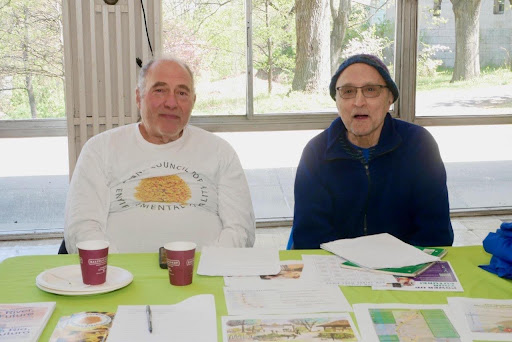
• Bronx Council for Environmental Quality (BCEQ)
How to Improve the Health and Recreational Use of the Harlem River
BCEQ is working to improve the Harlem River’s natural resources and its linkage to the East River, Hudson River and the overall New York Harbor Estuary. The BCEQ Harlem River Working Group is focused on revitalizing the Harlem River waterfront through community advocacy, habitat restoration and creation of a continuous Harlem River Greenway. This will be a green corridor along as much of the length of the river as possible with habitat buffers, a bike and walking path and river access points.
A key to this is a plan for a seven-mile cycling and walking route and new open space from Van Cortlandt Park to Randalls Island Park.
Contact: info@bceq.org, https://bceq.org
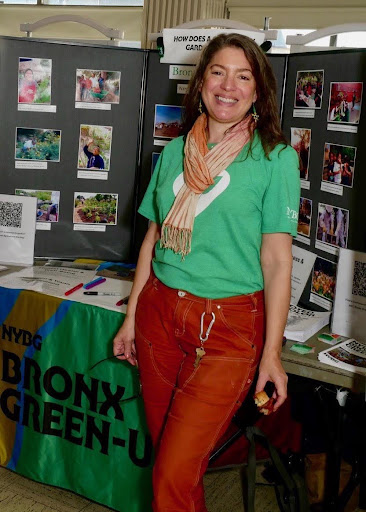
• New York Botanical Garden/Bronx Green-Up
How are Community Gardens in the Bronx Providing Access to Food, Building Spaces for Healing and Education While Leading the Fight Against Toxic Pollution
NYBG staff from the Bronx Green-Up Program discussed with students how community gardens can provide food and help shield Bronx residents, both physically and emotionally, from the harmful impacts of toxic pollutants, and from other stresses related to living in urban areas.
Bronx Green-Up coordinates the Bronx Community Farm network, a collaboration with more than 18 community gardens and farms and NYBG’s Edible Academy, that work together to coordinate within neighborhoods and share and garner skills and resources to increase the local production and distribution of produce to Bronx communities. (Source: NYBG Bronx Green-Up pamphlet)
Contact: NYBG Bronx Green-Up, 718-817-8700, https://www.nybg.org/gardens/bronx-green-up
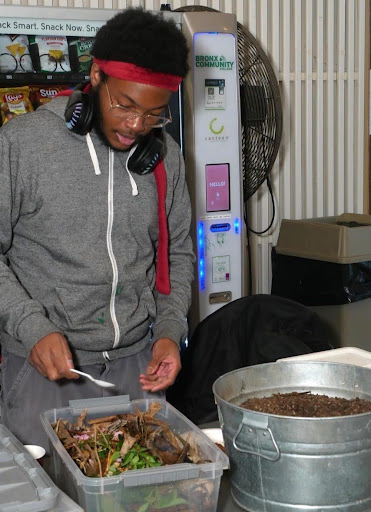
• Brotherhood Sister Sol
How Does Hot Box Composting Work
Hot box composting locks in heat and cooks compost. Inside the hot aerobics composting bin the temperature lies between 104–140 degrees F. The temperature is monitored with two thermometers, one buried in compost, one for the lid. The process is reliant upon supplying plenty of oxygen to decomposition and the promotion of necessary bacterial activity to break down waste into compost.
The hot bin is often manufactured from expanded polypropylene which is chosen for its insulation properties. It retains heat for longer and keeps bacteria working effectively.
(https://brotherhood-sistersol.org/programs/environmental-program/)
Contact: info@brotherhood-sistersol.org, 212-283-7044, https://brotherhood-sistersol.org
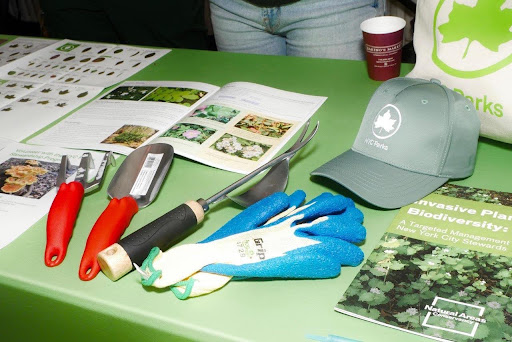
• New York City Parks Stewardship Program
How Does Street Tree Care Facilitate Habitat Restoration
The exhibit reviewed how school and community groups volunteer with the stewardship program to preserve and restore street trees.
Mulching street trees allows rainwater to be captured in tree pits, helping trees to thrive and halting runoff onto streets and into sewers. Planting in street tree pits absorbs rainwater and helps lead to restoration of urban areas.
Students learned that planting native species in a forest area in a NYC park provides all the benefits of trees to all the organisms in a habitat. Plantings hold the soil in place during rainfall preventing runoff of pollutants into streams, ponds and local coastal waters preserving water quality.
Contact: stewardship@parks.nyc.gov, https://www.nycgovparks.org/reg/stewardship
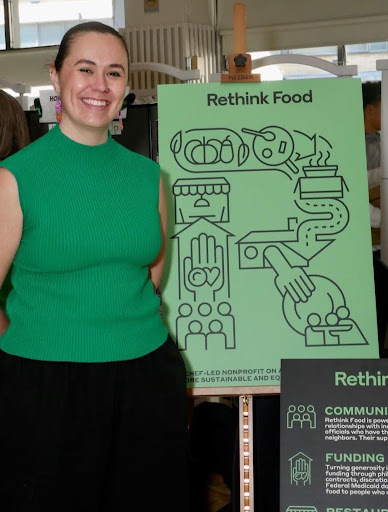
• Rethink Food
How to Create a More Sustainable and Equitable Food System
Rethink connects community-based organizations with local restaurants, kitchens and corporations to provide nourishing, culturally celebrated meals for food-insecure communities. Their Sustainable Community Kitchen prepares excess food into quality meals.
The process works by collecting excess food from partners. The culinary team created nutritious meals, and the trucking team delivers the meals to community-based organizations. Restaurant partners raise or receive food from Rethink Food, then prepare meals using excess food and provide those meals to local community-based organizations. (Source: Rethink fact sheets)
Contact: https://www.rethinkfood.org/
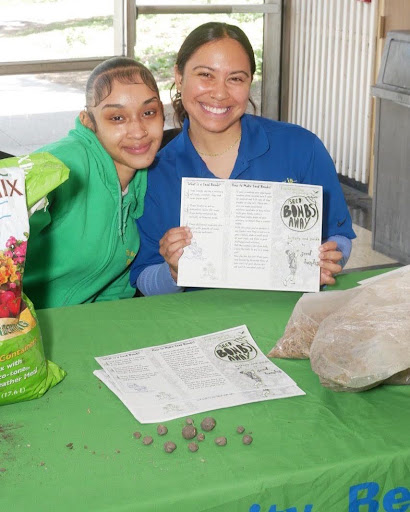
• The Bronx is… Blooming
How to Make a Seed Bomb
Students learned how to make a “seed bomb” with clay matrix, native plant seed, compost and paper pulp. They learned how to employ this process to select seeds and plantings that improve the ecological quality of green spaces (i.e., biodiversity and resilience) when urban gardening. Students also learned about the multiple programs offered by the organization and the potential for their involvement.
Contact: https://www.bronxisblooming.org/
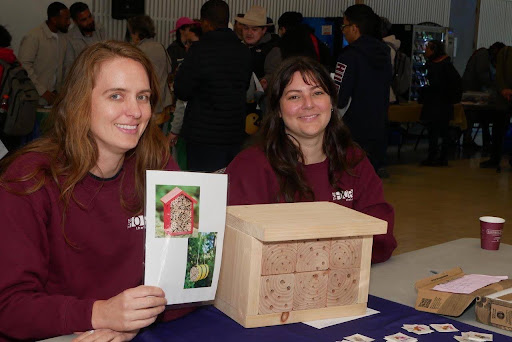
• The Hort
Pollinators are Everywhere
The Hort focused on “Pollinators are Everywhere,” informing kids about eight different pollinators.
Examples: Common Eastern Bumble Bee, a key native pollinator, particularly for tomatoes and blueberries. They use a technique called “buzz pollination” to shake pollen loose from flowers; Litigated Furrow Bee, one of the first bees to emerge in the spring, they are a diligent pollinator, especially of wildflowers; Painted Skimmer Dragonfly, an important predator of small insects, helping maintain a balanced ecosystem. (Source: The Hort fact sheet).
Flowers use colors, scents and nectar to attract pollinators such as bees and butterflies. Pollen adheres to the pollinator or is carried by wind to a flower’s male part (anther) and is transferred to the female part (stigma). The pollen travels down the style to the ovary and fertilizes the ovules, forming seeds.
Contact: https://www.thehort.org/
PUBLIC AND PERSONAL HEALTH
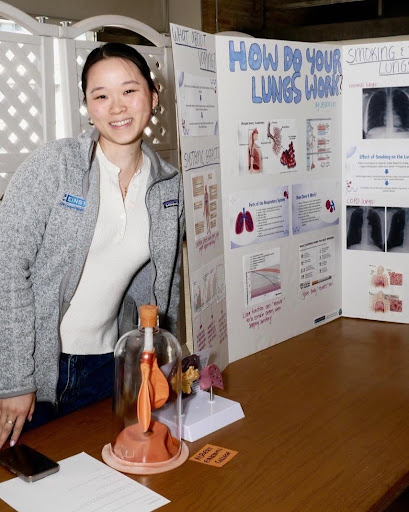
• Albert Einstein College of Medicine
How Your Lungs Work
Using attractive diagrams, the exhibit showed that lungs work by supplying oxygen to the body and removing carbon dioxide through a process called respiration. When you inhale, the diaphragm contracts, filling the lungs with air, which travels to alveoli to exchange oxygen for waste gases in the blood. The lungs also filter air using mucus and cilia.
The exhibitor went on to explain these functions more specifically and to outline the major components of the lungs.
(Source: American Lung Association, https://www.lung.org/lung-health-diseases)
Contact: Jessica Lin; jessica.lin@einsteinmed.edu
• Biobus
How a Microscope Works
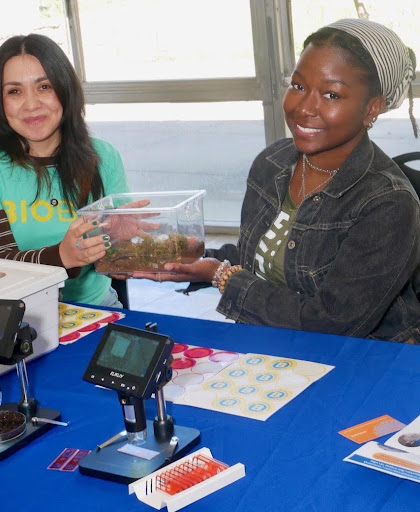
BIOBUS uses its bus equipped with a $75,000 microscope and staffed by scientists to teach science to inner city youth. Their exhibit used mini-microscopes to demonstrate how to see very small organisms.
Contact: Barry Koran, Director of Community Science, Bronx, barry@biobus.org, 917-310-3941, https://www.biobus.org
• Bronx Community College
Poster Exhibit on How to Implement Weather Aided AI Calibration of Monsoon Rainfall in India
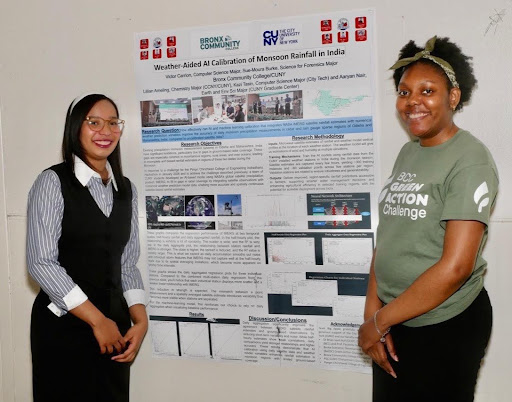
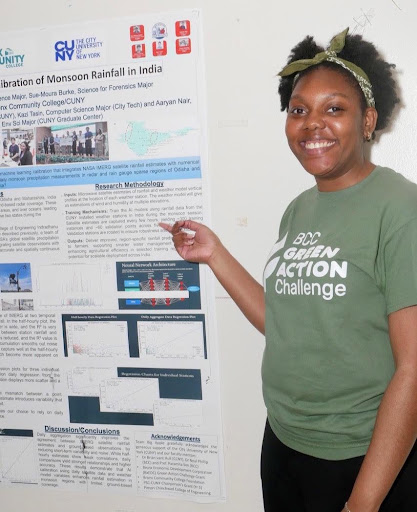
BCC students on their field study in India, used rainfall data from City University of New York (CUNY) installed weather stations during monsoon season, to train AI models. This delivered improved region-specific rainfall predictions to farmers supporting smarter water management and enhancing agricultural efficiency.
Contact: Elena Perez, elena.perez@bcc.cuny.edu, BCC Green Action Challenge
• Bronx Tech Hub
How to Bring Training in Climate Related Technology to the Bronx
The Hub brings technological training and solutions to the Bronx by partnering with the New York Power Authority and the Bronx Economic Development Corporation to provide Bronx climate technology fellowships for Bronx college students. Two of their fellows educated the attendees about the program at their exhibit.
Contact: George Nuñez, https://www.bronxtechhub.org/
• New York City Department of Health and Mental Hygiene (DOH)
How Climate Change Contributes to Mosquito-Borne Diseases in NYC; How Diseases are Transmitted by Mosquitoes and How Disease Can Be Prevented
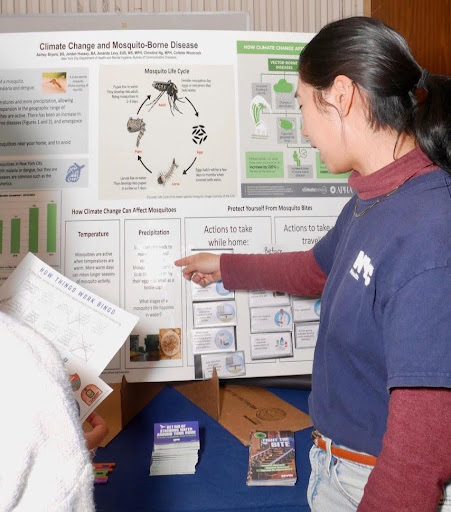
Agency scientists demonstrated to students how climate change can lead to an increase in infectious diseases transmitted by mosquitoes and ticks such as Lyme Disease or West Nile Virus. These diseases may spread to previously unaffected areas as warmer temperatures provide more advantageous conditions for mosquitoes and ticks to live. Increased rainfall creates more standing water and expands breeding grounds for mosquitoes.
Students also learned aspects of tick identification and removal and about the interventions which can prevent the transmission of disease such as wearing long sleeves, applying mosquito repellent, removing standing water sources and vaccinating against vector borne diseases when traveling outside the United States.
Contact: Christina Ng, cng1@health.nyc.gov, https://www.nyc.gov/site/doh/
• New York City Department of Transportation (DOT)
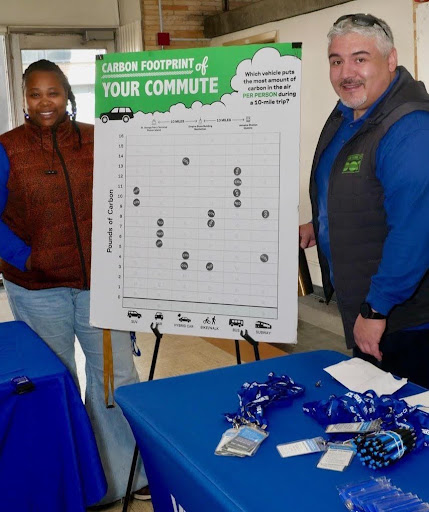
How Can Traffic Fatalities in NYC Be Reduced; How Can We Reduce Our Carbon Footprint
Vision Zero is a program to eliminate traffic fatalities and serious injuries in NYC through street design, enforcement of speed limits, red light and bus lane cameras and encouraging safe driving through education. The DOT exhibit highlighted this issue.
For DOT, the carbon footprint is the amount of greenhouse gases including carbon dioxide and methane that each person emits when traveling approximately ten miles. DOT staffers discussed with the students how to determine their carbon footprint and how to reduce it, for example, by traveling by public transportation or walking rather than driving when possible.
Contact: 718-433-3100, https://www.nyc.gov/content/visionzero/pages/
• New York Sea Grant
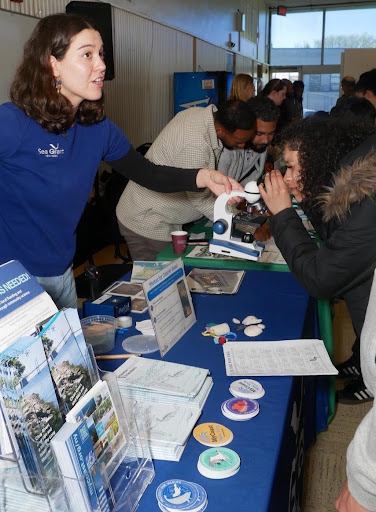
How to Remove Plastic from Water
New York Sea Grant’s exhibit showcased new technology that removes plastic from water. Plastic pollution is one of today’s most pressing environmental concerns, because plastic doesn’t biodegrade. Instead, plastic breaks down into microplastics, which participants were able to see firsthand at New York Sea Grant’s table. After looking through the microscope and guessing which household items the microplastics came from (a sponge and fleece jacket), participants learned how cameras can identify plastic, through spectroscopy and Artificial Intelligence (AI). New York Sea Grant is partnering with Columbia University researchers to develop an AI-system that cleans plastic from water. The system is being trained with community-sourced photos of floating debris uploaded to https://mycoast.org/NY/LitterWatch. New York Sea Grant’s exhibit featured these photos and encouraged participants to submit their own!
Contact: Catherine Prunella, Water Quality Extension Specialist, New York City;
New York Sea Grant-Cornell University; cjp275@cornell.edu, 718-502-8092, https://seagrant.sunysb.edu
• South Bronx Unite
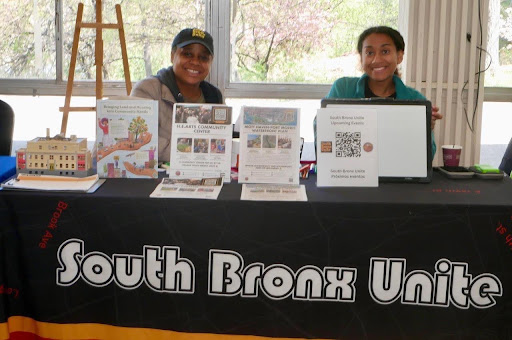
How Can the Mott Haven Community Work to Make Air Quality, Housing and Land Use Better for Its Inhabitants
South Bronx Unite is working for cleaner air in Mott Haven, which has the worst air pollution in New York State and among the highest asthma rates in the nation, by installing air monitors across the neighborhood. They are trying to prevent gentrification and demand that 100% of new housing be affordable to the average family in the area. They have created the Mott Haven-Port Morris Community Land Stewards to advocate for an accessible waterfront, more green spaces and a new community center.
The Mott Haven-Port Morris Waterfront Plan would:
- Create a network of connected open green spaces and access to the waterfront.
- Help produce clean air in this disproportionately pollution burdened community.
- Address pollution related illnesses and create better health outcomes.
- Protect the community from river flooding as they are in a high-risk flood zone.
- Allow the community to manage the waterfront green spaces and determine how they are used, centering local priorities and increasing empowerment for generations.
(Source: South Bronx Unite)
Contact: https://www.southbronxunite.org/
• Unearthing Air with Todd
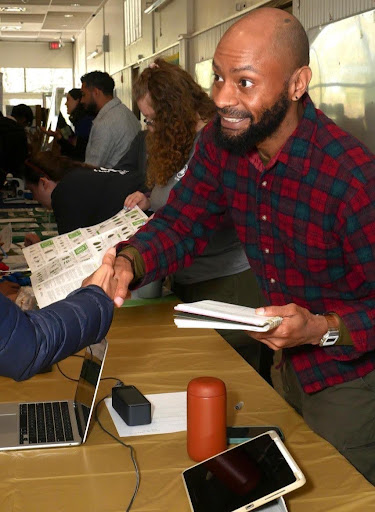
How to Measure Indoor Air Quality
Todd showed students how to develop air quality monitoring systems based on the needs of individual homes and other indoor environments. He demonstrated to youth that particulate pollution can be generated in the home during cooking, cleaning and combusting. He explained how each of these processes contributes to overall air quality. He displayed specific air monitors that can deal with specific pollutants.
Contact: Todd Whitney, toddw@nyu.edu, https://airink.raretodd.com/
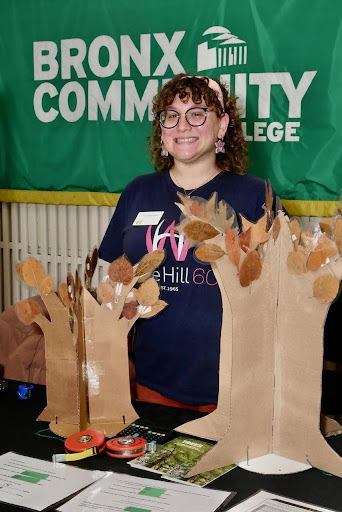
• Wave Hill
How Can Youth Learn About Urban Biodiversity, Forest Health and Climate Change
The exhibit covered Wave Hill’s Youth Research and Restoration Career Pathways, Woodland Ecology and Restoration Mentorship, and Forest Project Initiatives. The exhibit took students through a process of learning how to identify and measure a tree to determine how much carbon is stored in it.
Contact: ilana.weinstein@wavehill.org, https://www.wavehill.org
EVALUATION
Due to the hustle and bustle at the end of the conference, with students returning to their buses, it was difficult to get written evaluations from the teachers. Three filled out the forms; their responses were extremely positive.
In response to the question, “Do you think the experiences at the exhibits will have an impact on any of your students, one teacher said, “I certainly hope so, we learn about Earth’s energy and most of the booths support what they are learning.”
When asked about vignettes from the conference the same educator said, “Seeing so much interest among all the students.”
A teacher from a different school, when asked, “Were your students interested in the exhibits”, said “My students were very interested in the exhibits. They expressed so much excitement to me.”
When asked about replicating any of the exhibits or the overall “How Things Work” conference idea, that teacher said, “Yes, I will be talking to my director about a possible partnership.” With respect to vignettes the teacher said, “This conference was an excellent way of getting students involved in different STEM fields. My most quiet students were very active in the activity today.”
A third teacher from another school, in response to the student impact question wrote, “Yes. I believe they gained inspiration and ideas for creating sustainable options for a healthier Earth.” With respect to the question about exhibit or conference replication that educator said, “Yes. The Enviroscape was a great learning tool to understand watershed dynamics and the importance of not littering and not using toxic substances.”
Twenty-five of the twenty-nine exhibitors submitted evaluations. Again, they were extremely positive.
One exhibitor wrote, “Students enjoyed seeing the model. They appreciated relating their everyday life and environment to flooding issues the city experiences, e.g., a student from Mott Haven said it gave him a better understanding of how flooding happens near his school.”
A second wrote that one group of students also attended last year’s HTW conference and were so excited to attend again!
Juan Torres of the New York League of Conservation Voters wrote in response to the question, “Were students engaged when they visited your exhibit” — “Yes, we were really impressed with the insightful thoughts and questions that the students brought with them today.”
With respect to vignettes, Juan Torres related that, “We had a group of students teach us about why batteries are important and how disposing of them the proper way affects us all.” “Some students were really informed on windmills and what they actually do for the community.” Juan stated that some students had been on electric buses and can tell the difference in air quality in comparison to using vehicles powered by fossil fuels.
One exhibitor had two teams from the same high school competing in the Power Game. They were very into the game and learned a lot about electricity generation.
Staff from the NYC Department of Parks Stewardship team said many students were asking about what type of volunteering the department offers.
In relating a vignette, the staffer from Sea Grant wrote that a student knew the instrument she was using was a spectral camera. She congratulated the youth on knowing that and he told her how much he loves STEM.
The Hort wrote that students were very excited about bees and to share what they already know about pollinators.
When commenting on whether students were engaged when they visited their table, the Bronx is Blooming staff member related that kids of all ages were excited and that some 6th graders came back again to make more seed bombs.
The staffer from the Einstein School of Medicine stated that students engaged with the lung model, asking details about how vaping specifically affects the lungs.
Bronx Tech Hub felt it was “important to note the number of Spanish speaking students looking for information on our fellowship.”
CREDITS
Elena Perez, Director of the Bronx Community College Green Action Challenge, was the principal organizer of the conference.
She was assisted by a committee of EEAC steering committee members consisting of Ray Pultinas, Dan Tainow, Judith Velosky, Ilana Weinstein and Mike Zamm.
All photos are by Karen Schulz; photo insertion into the document and additional editing was done by Amanda Levy of EEAC.
Formatting and editing this document for the EEAC website done by Shig Matsukawa of EEAC.